Flip Charts Don't Make Decisions: Reengineering the Executive Offsite as a Decision Factory
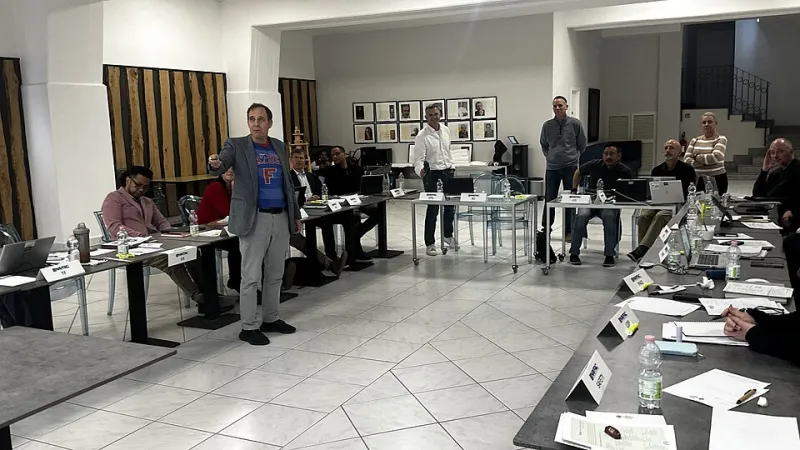
Photo: U.S. Navy NAVFACEUR by Anthony Cage, Public domain, via Wikimedia Commons
The executive offsite has become a fixture of corporate life. Senior leaders gather at a conference center, review presentations, discuss strategy, and leave with warm feelings and glossy flip charts. Yet the output is often thinner than the atmosphere suggests. Consensus in the room does not always become commitment in the organization. Real strategic tensions remain untouched, and the hardest choices are deferred to another meeting that never quite happens.
Retreats usually fail before they begin. The agenda is built around topics rather than decisions. Pre-reads arrive late or not at all. Some participants arrive without the authority to commit resources. The facilitator optimizes for harmony. The room avoids trade-offs because no single leader owns them. By the end, the team has aligned on language but not on priorities, budgets, or behavior.
Why Retreats Fail Before They Begin
An offsite is not a break from work. It is a concentrated form of work. When its purpose is vague, the room fills the vacuum with presentations. When decision rights are missing, the group produces recommendations instead of decisions. When agreement is choreographed, dissent goes underground and reappears later as slow execution.
The first design question is not who should attend or where the event should be held. It is this: which decisions must be made in this room? If the answer is unclear, the offsite will default to a team-building exercise with a strategy label.
Design Principle: Every Session Ends with a Decision
A useful offsite is built around a decision docket. For each major session, the organizer should specify the decision to be made, the executive owner, the decision type, the criteria for evaluation, the options under consideration, and the deadline. If a topic cannot produce a decision, it does not belong in the plenary. It belongs in a pre-read, a working group, or a future meeting.
The decision docket should be sent at least two weeks in advance. Participants should be required to submit positions, not slide decks. Invitations should be limited to decision-makers and the experts needed to inform them. A room of thirty people is rarely a decision factory. A room of eight with clear authority often is.
Force Trade-Offs, Not Themes
Strategy is choice under constraint. An offsite that discusses growth, innovation, talent, and customer experience without forcing trade-offs is not doing strategy. It is doing taxonomy. The agenda should force explicit choices: growth versus margin, speed versus quality, one customer segment versus another, build versus buy, centralization versus autonomy.
Constrained scenarios are useful. Ask the team what it would cut if it had 70 percent of the planned budget. Ask which initiative would be killed to fund the new priority. Ask which customer promise the company is willing to weaken in order to improve profitability. Have executives write their preferred trade-offs before discussion begins, so the conversation is less vulnerable to anchoring by the most senior voice in the room. Then use silent sorting and structured debate to expose the real disagreements.
Assign Owners Before the Room Empties
No decision should leave the room without an owner, a date, a metric, and a first step. The decision log is the most important document produced at an offsite. In the final hour, the facilitator should read back every decision, every deferred item, and every assigned owner. Distinguish clearly between decided, to be tested, and not decided. For deferred items, name the decision owner and the deadline. Avoid assigning action items to committees. Committees are where urgency goes to expire.
Choreographed Agreement Is the Enemy
If everyone agrees early, the facilitator should be suspicious. Early unanimity often means the room has not yet surfaced the real conflict. Assign a devil's advocate for each major decision. Use a red team to argue the opposite case. Ask what would make the decision wrong, who loses if it is right, and what the team is not saying out loud. Leaders must model dissent rather than punish it. A decision factory values productive conflict over comfortable silence.
A Sample One-Day Docket
A focused offsite might devote the morning to two decisions: capital allocation and organization design. The afternoon could take up go-to-market priorities and risk appetite. Each session can run 75 minutes: ten minutes of framing, twenty minutes of option review, thirty minutes of debate, ten minutes of decision, and five minutes for owner and next step. Breaks matter, but presentation marathons do not. Pre-reads should carry the information; the room should carry the judgment.
Follow-Through Is the Real Test
Within 48 hours, the organizer should circulate the decision log with owners, dates, metrics, and open questions. At 30 days, the executive team should review implementation and surface drift. At the next offsite, the first agenda item should be a decision audit: which decisions held, which were quietly reversed, which owners need help, and which assumptions proved wrong. The offsite is not a retreat from accountability. It is one of the few settings where accountability can be designed deliberately. When the flip charts are gone, the decisions should still be standing.